

You spot a patch of mould on your bread and wonder: can I cut off that bit and eat the rest? The question is more common than you think, and the answer is a little more uncomfortable than most people hope. Here are the facts about mould in bread: what it is, whether it is dangerous, and how to avoid it entirely.
Why you should not cut off the mould
The mould you see, the green, white or black patches, is only the "fruit". Beneath the surface grows a web of invisible threads, called hyphae, that reach deep into the soft bread. In firm foods like hard cheese you can cut a good margin around a patch, because the threads do not travel far. But bread is soft and airy, and there the threads spread freely. Once you see the patch, the loaf is already woven through, and cutting off a piece does no good.
Is mould in bread dangerous?
For most healthy adults, a small piece of mouldy bread rarely causes more than a little stomach discomfort. But some types of mould form mycotoxins, toxic substances that can be harmful to health over time and are not destroyed by toasting or baking. You cannot tell from a patch whether it is harmless or toxic. So the advice is simple: if the bread is mouldy, throw it out. And do not sniff it hard to check either, you do not want to breathe in a cloud of spores.
How to recognise mould
Mould is almost always furry or powdery, in green, white, grey, blue or black. It is easy to confuse with two other things:
Dry, white powder with no structure, often from a proving basket or from baking. Harmless.
Raised, furry growth, often coloured and with "rings". Throw away the entire loaf.
If in doubt, the same rule applies as with any food: better to leave it.
When does bread go mouldy fastest?
Mould thrives in moisture and warmth, so the risk varies with the season and the kitchen. In summer, in a warm, humid kitchen, bread can go mouldy in a few days, while a cool, dry room in winter gives slower growth. Sliced bread goes mouldy faster than a whole loaf, because the cut surface gives spores an open way in, and home-baked bread without preservatives is more vulnerable than much shop-bought bread.
The steps therefore matter even more when it is warm: cool it completely, store it so it can breathe, and freeze what you do not eat quickly. Read more about how long home-baked bread keeps.
How to avoid mould in the first place
Mould needs moisture, warmth and time. Remove the moisture and you remove most of the problem:
-
1Cool the bread completely before storing
Warm bread in a closed bag creates condensation, and condensation is mould's best friend.
-
2Choose breathable storage
A bag that lets excess steam escape stops moisture from gathering. Plastic does the opposite.
-
3Freeze what you cannot finish
Freezing stops mould completely. Freeze the bread while fresh, ideally in slices.
-
4Keep your storage clean
Wash the bread bag or box regularly, so spores do not build up over time.
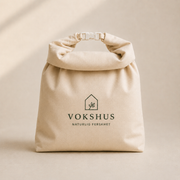
A Vokshus bread bag in cotton and linen with natural beeswax breathes with the bread and keeps the moisture in balance, so the bread stays fresh for 7-10 days without the condensation that plastic creates. It costs from 299 kr. If you want to understand the mechanism better, we have written about why home-baked bread goes mouldy.
Mould vs drying out: two different problems
Bread "goes bad" in two ways. Drying out is simply a loss of moisture. A dry loaf is safe to eat and can be revived in the oven. Mould is biological growth and makes the bread unsafe. Proper storage slows both, but in different ways: against drying out you want to hold on to the moisture, against mould you want to let the excess out. A breathable bag does both at once. Read more about a beeswax bag versus plastic.
Common mistakes
The threads weave through the whole porous loaf.
You breathe in spores, avoid it.
Condensation gives mould perfect conditions.
Mould never gets a foothold.
Frequently asked questions
Can I eat bread if I cut off the mould?
Is mouldy bread dangerous?
Why does home-baked bread go mouldy faster?
Does the fridge help against mould?
Be done with mouldy bread for good
Vokshus Bivoks™ bread bag in cotton and linen. Breathes with the bread, no condensation.
See the bread bag →- 365-day guarantee
- ·
- Free shipping over 400 kr
- ·
- Delivery 7-10 days