

Few things disappoint more than a baguette that was crisp this morning and chewy by evening. It is rarely the baker's fault. With the right storage and a few minutes in the oven, you can bring the crunch back, even the day after.
Why a baguette turns soft within a few hours
A baguette is almost all crust: long, narrow and with a shell only a couple of millimetres thick. From the moment it has cooled, moisture travels from the crumb outwards, and the crust becomes saturated within two or three hours, while it also draws moisture from the kitchen air. The result is a crust that bends instead of snapping.
Plastic bags: the worst place for crusty bread
Crusty bread suffers most in a plastic bag, because the whole point is the crust. Plastic lets no air through: the moisture is trapped inside as condensation and soaks straight into the crust, and the baguette turns soft and chewy within an hour or so.
The paper-bag myth: dried out in a day
"Just put it in the paper bag from the bakery" is well meant, but short-sighted: paper breathes too well, and the moisture escapes, including the moisture the crumb needs. The bag is fine until dinner; the next morning the baguette is dry and hard all the way through.
Day 1: how to keep the baguette crisp until evening
If the baguette is to be eaten the same day, it is enough to avoid the traps: room temperature, a dry spot, away from sunlight and the heat of the cooker, and never in the fridge. If you have cut off a piece, set the cut face down against the chopping board. You will find more traps in the guide on common bread storage mistakes.
Day 2-3: revive the baguette in the oven
The heat drives the moisture out and makes the crust crisp again. Preheat the oven to 200 °C, dampen the crust lightly with wet hands, and put the baguette straight onto the rack for 5-7 minutes. Let it rest a couple of minutes before you slice it. One honest warning: the crumb dries a little with each round, so the trick works once, perhaps twice.
Freeze what you cannot finish
If half the baguette is left over, the freezer is the most honest advice. Cut it in two, wrap it tightly, and freeze it the same day. The frozen half goes straight into the oven at 200 °C for 8-10 minutes, and the result is surprisingly close to freshly baked.
Thick crust versus thin: sourdough is a different story
Everything about hours and days applies to the thin baguette crust. A sourdough loaf with a thick, dark crust plays in a different league: the crust acts as the bread's own packaging and holds the moisture much longer. Read more about how long homemade bread stays fresh. For a baguette, think in terms of 1-3 days, with a revival along the way. If you bake your own, we have a dedicated guide to storing sourdough bread.
The Bivoks™ bread bag: the balance between breathing and moisture
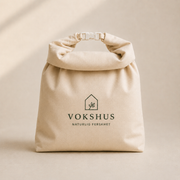
Crusty bread needs something midway between plastic and paper, something that lets moisture out so the crust does not soften, without drying out the crumb. That is the balance a Bivoks™ bread bag is made for. The bag is sewn from cotton and linen, with a thin layer of natural beeswax and jojoba oil on the inside. The fabric breathes, so condensation never settles on the crust, and bread with a good crust stays fresh for 7-10 days in the bag.
Traps the moisture inside: the crust is soft within an hour or so, and mould thrives after 2-3 days.
Breathes too well: fine until dinner, but the baguette is dry and hard by the very next day.
Lets the condensation out and slows the drying, so the crust keeps its spring and the crumb stays soft.
In practical terms, the bag measures 30 × 43 cm, so cut the baguette in two and both halves will fit. The bag closes with a clip, can be reused for 12 months or more, and replaces over 200 plastic bags.
Frequently asked questions
Can you store a baguette until the next day?
Why does the crust go soft in a plastic bag?
Does reviving a baguette in the toaster work?
Should a baguette be stored in the fridge?
How long does crusty bread keep in a beeswax bread bag?
Give the crust an honest chance, tomorrow too
A Bivoks™ bread bag from Vokshus costs from 299 kr, and lets crusty bread breathe without drying out.
Vokshus Bivoks™ bread bag in cotton and linen, crisp crust for 7-10 days.
See the bread bag →- Cotton and linen
- ·
- Closes with a clip
- ·
- Reusable for 12+ months