
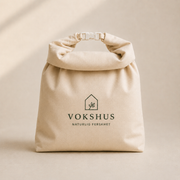

Beeswax bag or plastic bag for your bread? The plastic bag has been standard for fifty years — free, light, always at hand. Yet bread often ends up in the bin: soggy crust after one day, mould spots after three. Here we compare them point by point — freshness, crust, mould, environment and cost.
The plastic bag: why it fails your bread
Plastic is watertight. For bread, that is the problem: a newly baked loaf releases moisture for hours, and in a plastic bag it condenses inside and settles on the crust.
You know the result — the crust that crackled in the morning is rubbery by evening. That warm, humid environment is exactly where mould thrives, so bread in a plastic bag often goes mouldy after two–three days. Plastic in contact with food can also shed microplastics. Read more about why homemade bread goes mouldy.
The beeswax bag: natural materials that breathe
The Vokshus bread bag is woven from cotton and linen — natural materials that breathe. The inside is treated with natural beeswax and jojoba oil, a coating that lets excess vapour out without drying the bread. The crust stays crisp, the crumb stays soft, and the condensation that causes mould never settles. In practice, homemade bread stays fresh for 7–10 days.
What the Bivoks™ bread bag is made of
- Cotton and linen (outside) — woven natural fibres that let air through
- Natural beeswax (inside) — regulates moisture around the bread
- Jojoba oil — keeps the wax coating supple and durable
- Clip closure — easy to open and close, even for stiff morning fingers
The bag measures 30 × 43 cm — plenty of room for a large, rustic loaf.
Beeswax bag vs plastic bag: the comparison
The five points that matter most in everyday life, side by side:
| Plastic bag | Beeswax bag | |
|---|---|---|
| How long the bread keeps | 2–3 days | 7–10 days |
| The crust after day one | Soggy and rubbery | Crisp |
| Mould risk | High — condensation gives mould perfect conditions | Low — the bag breathes, avoiding condensation |
| Environment and microplastics | Single-use plastic, can shed microplastics | Cotton, linen and beeswax — no microplastics |
| Cost per year | Many bags, all in the bin — plus the wasted loaves | One bag, under 1 NOK per day |
Day by day: what happens inside the bag?
The difference shows fast. In the plastic bag, condensation appears inside by the first evening, on day two the crust is soft and chewy, and from day three the first mould spots are rarely far away.
In the beeswax bag, moisture is balanced hour by hour — enough to keep the crumb soft, little enough that the crust still crackles. The bread slices well on day five and is fully edible well into week two.
The environmental ledger: over 200 bags a year
For a household that bakes regularly, plastic bags add up fast over a year.
The bag itself is cotton, linen, beeswax and jojoba oil — only natural materials, no plastic to break down in nature.
The economics: what does it really cost?
The Vokshus bread bag costs from 299 NOK and is made to last 12+ months — under 1 NOK per day. Every half-eaten loaf you bin, meanwhile, costs a whole loaf plus the hours of dough, proofing and baking. See the Vokshus bread bag here.
How to get the most from your beeswax bag
-
1Let the bread cool completely
Put it in the bag only when fully cooled. Steam from a warm loaf is unnecessary moisture.
-
2Close the bag with the clip
Store the bag at room temperature. Avoid the fridge — bread dries out faster there.
-
3Shake out the crumbs
Shake out the crumbs between loaves so the bag stays fresh longer.
-
4Wash the bag when needed
See our guide on how to wash a beeswax bread bag.
Conclusion: nature won this round
The plastic bag is free, but you pay in soggy crust, short shelf life and binned bread. A bag of cotton and linen with a natural beeswax coating gives you fresh bread, crisp crust and zero microplastics — how bread was kept for generations before plastic. With the Bivoks™ bread bag, the old solution is back, in a form that fits your kitchen today.
Frequently asked questions
How long does bread stay fresh in a beeswax bag?
Does the beeswax bag work for store-bought bread too?
What do I do when the wax coating starts to wear?
Is the beeswax bag hard to keep clean?
Swap the plastic bag — keep the crust
Vokshus Bivoks™ bread bag in cotton and linen — crisp crust for 7–10 days.
See the bread bag →- 365-day money-back guarantee
- ·
- Free shipping over 400 NOK
- ·
- Delivery 7–10 days